Forty Papers Before Sunrise: The Vanishing World of America's Paperboy
Forty Papers Before Sunrise: The Vanishing World of America's Paperboy
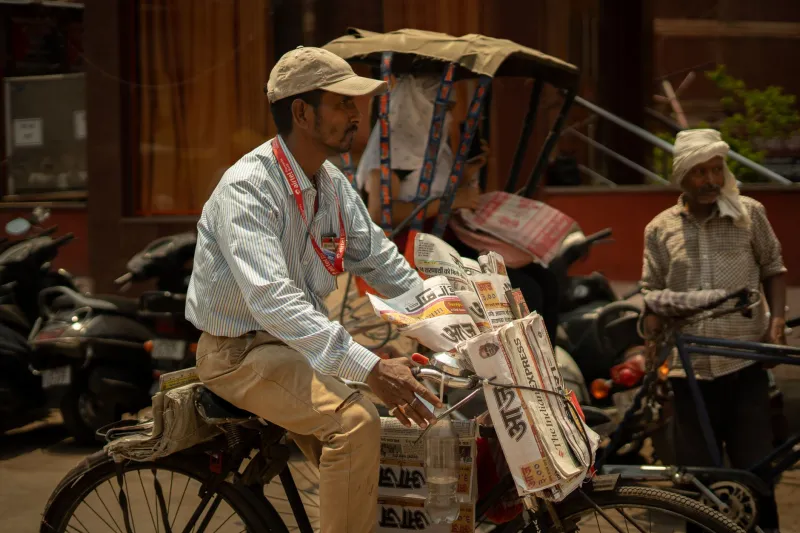
Somewhere around 4:30 in the morning, before most of the neighborhood had cracked an eye open, a kid was already working. He'd rolled out of bed in the dark, pulled on whatever layers the season demanded, grabbed his canvas bag, and started folding. Forty papers, sometimes sixty. Each one creased into a tight baton that could arc through the air and land — if he'd practiced, and he had — right on your front step.
That was the paperboy. And for most of the twentieth century, he was as reliable as the sunrise he beat to your door.
A Real Job, Not a Chore
It's easy to romanticize the paperboy as a nostalgic symbol, a Norman Rockwell footnote. But the job was genuinely demanding in ways that most adult positions today aren't. A carrier didn't clock in for a boss. He was the boss — responsible for his own route, his own collections, his own customer service, and his own arithmetic.
In the classic model, the carrier bought his papers from the publisher at wholesale cost and sold them to subscribers at retail. The margin was his profit. If a customer didn't pay, that was his loss. If a paper landed in the bushes instead of on the porch, he'd hear about it personally — not through an app review, but at the door, from the customer's actual face.
That accountability was the whole point. Newspapers actively marketed their routes to parents as character-building enterprises. The industry ran programs, published pamphlets, and held banquets for top carriers. The Independent Newspaper Boys of America had chapters across the country. Boys — and eventually girls, though the industry was slow to acknowledge it — learned to manage money, plan logistics, and deal with difficult people before they were old enough to drive.
What today's gig economy sells as "entrepreneurship" was just called Tuesday.
The Route as a Social Map
Here's what the paperboy knew that nobody else did: everything.
Because he came every single day, he noticed when the lights were on at odd hours. He noticed which houses had the curtains drawn for a week straight. He knew who tipped generously at Christmas and who pretended not to be home when he came to collect. He knew which dogs were bluffing and which ones weren't.
In a very real sense, the carrier was an informal census of his block. He accumulated the kind of granular neighborhood knowledge that only comes from daily physical presence over months and years. Elderly residents who lived alone often saw the paperboy as a quiet form of safety net — if the paper piled up uncollected, someone would notice.
There are documented cases of carriers raising alarms when elderly customers didn't retrieve their papers for a day or two. That's not a policy. That's a kid who knew his route well enough to recognize when something was wrong.
What Killed the Route
The decline wasn't sudden. It was a slow erosion that began when newspapers started cutting costs in the 1980s and accelerated through the 1990s and 2000s as circulation fell. Publishers shifted from child carriers to adult drivers — people in cars who could cover larger territories faster but who had none of the neighborhood intimacy the old model depended on.
Then the internet finished the job. Why pay for a paper subscription when the same content was free online? Circulation collapsed across the country. The Boston Globe, the Chicago Tribune, the Los Angeles Times — every major metro daily watched their numbers crater. When the papers shrank, the routes vanished.
 Photo: Los Angeles Times, via ca-times.brightspotcdn.com
 Photo: Chicago Tribune, via www.chicagotribune.com
 Photo: Boston Globe, via www.bostonglobemedia.com
By 2010, the image of a kid on a bicycle with a canvas bag was already more memory than reality. Today, in most American cities, your newspaper — if you still get one — arrives in a plastic sleeve tossed from a car window by an adult contractor you will never meet, never tip, and never know by name.
The Price of Invisible Delivery
What's lost isn't just a job. It's an entire structure for introducing young people to economic reality.
The paperboy route was one of the few genuine entry points into financial responsibility that didn't require a work permit or a parent's signature on a W-4. It taught compounding through experience: the more customers you kept happy, the more tips you earned at the holidays, the more you could save, the more you understood that reliability had a dollar value.
Today, the average American teenager's first exposure to financial systems is a debit card linked to a parent's account. The distance between spending and earning is abstract. For a kid who'd collected door to door on a Saturday morning, that distance was measured in steps, not swipes.
There's also something worth noting about physical presence. The paperboy's route was an argument — made daily, in person — that information had weight. That it traveled through weather and darkness and the arms of a real human being to reach you. The news wasn't pushed to your phone. Someone brought it.
Then and Now
At its peak in the mid-twentieth century, an estimated 800,000 American kids worked as newspaper carriers. Today that number is a fraction of what it once was, and the role itself has been fundamentally transformed — from a child-run micro-business into an adult gig with none of the community texture.
The morning paper still exists, technically. But the experience surrounding it — the kid who knew your name, who you tipped at Christmas, who you called when your paper landed in the gutter — that's gone. Replaced by an algorithm that decides what you read and a stranger in a car you never see.
Somewhere in that trade, we gave up more than we probably realized.