Cake, Crepe Paper, and the Kid From Three Houses Down: The Birthday Party We Stopped Throwing
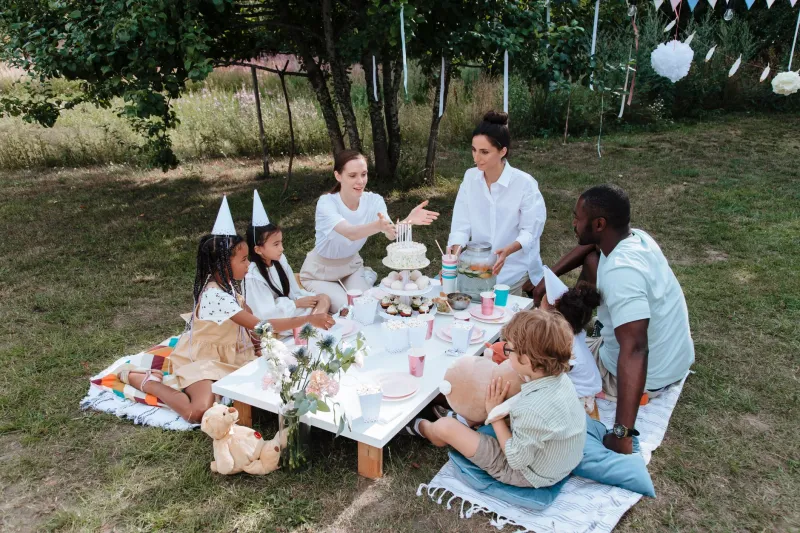
Somewhere around the mid-1990s, the American birthday party quietly changed jobs. It stopped being a neighborhood ritual and became a production. Not overnight — these things never happen overnight — but gradually, steadily, until the version your parents threw for you and the version parents throw today are barely recognizable as the same event.
This isn't nostalgia for nostalgia's sake. It's worth actually looking at what shifted, because the gap between then and now is wider than most people realize.
What a Birthday Used to Look Like
In the 1950s, '60s, and well into the '70s, a child's birthday party was a neighborhood affair. Mom would bake a cake from scratch — or from a box, once Betty Crocker made that socially acceptable — and the guest list was basically whoever lived on the street. Six kids, maybe eight. The invitations, if there were any, were verbal. "Saturday afternoon, come over after lunch." That was the whole system.
Decorations meant crepe paper twisted across the ceiling and a tablecloth from the five-and-dime. There might be pin the tail on the donkey. There might be a sack race in the yard. The party lasted two, maybe three hours, and when it was done, the kids scattered back to their own houses with a piece of cake wrapped in a paper napkin and a balloon if they were lucky.
The budget? Adjusted for inflation, historians who've tracked household spending put the average mid-century birthday party at somewhere between $20 and $40 in today's dollars. The return on that investment, if you asked the kids involved, was enormous.
When Parties Became Events
The shift started gaining momentum in the 1980s. Chuck E. Cheese opened in 1977 and quietly rewired what a birthday could be — suddenly there was a venue, a place outside the home, with games and noise and a staff that handled the cleanup. Parents noticed. The idea spread.
By the 1990s, the entertainment industry had fully discovered the birthday market. Party supply stores multiplied. Licensed character themes — Barbie, Ninja Turtles, later Frozen and Paw Patrol — turned a birthday into a branded experience. The party wasn't just a gathering anymore. It had a concept.
Today, the average American family spends somewhere between $300 and $500 on a child's birthday party, with a significant portion of parents in urban and suburban areas reporting they've spent over $1,000. Venues book up weeks in advance. Some require deposits. Party planners — actual professional party planners — exist specifically for children's events. There are companies whose entire business model is delivering themed balloon arrangements to your door.
Pinterest, Instagram, and parenting blogs have created a visual benchmark that simply didn't exist before. The homemade cake that once represented love and effort now risks looking, in the social media frame, like a failure of ambition.
The Hidden Cost Nobody Talks About
Here's the part worth sitting with: the elaborate party, for all its color and spectacle, tends to be a fundamentally passive experience for the children attending it. You arrive at a venue. Staff runs the activities. A pre-ordered cake appears. You watch an entertainer perform. You leave with a goody bag assembled by someone who doesn't know your name.
The old backyard party, by contrast, was messy and improvised and deeply social. Kids had to do something — organize the games themselves, negotiate the rules, fill the time. The birthday child was at the center of a real community, however small, not a ticketed event.
There's a reason child development researchers have spent the last two decades talking about the importance of unstructured play and organic social interaction. The birthday party, once a natural incubator for both, has in many cases become the opposite: a highly structured, adult-managed production that children experience rather than participate in.
None of that is an argument against fun. It's just worth noticing.
What We Gained, What We Traded
Fairness demands acknowledging what the modern birthday party does well. There's genuine creativity in themed events. There's real joy in a child who gets the exact party they imagined. Inclusive guest lists at neutral venues can sidestep the social dynamics of whose house is big enough or nice enough. Not every family has a backyard.
But somewhere in the upgrade, the neighborhood vanished from the equation. The kid from three houses down — the one who got invited because she was there, because that's how it worked — doesn't make the curated guest list anymore. The party has become an investment, and investments get managed carefully.
The spontaneity is gone too. A party that requires a venue booking six weeks out and a color-coordinated dessert table has, by definition, lost the quality that made the old version feel like a gift: the sense that it happened because people wanted to be together, not because the calendar said so.
A Different Kind of Enough
There's a version of this story that ends with a call to go back to crepe paper and sack races. That's not quite the point. The point is that enough used to mean something different — and it worked. A cake and the neighborhood was genuinely sufficient. The kids were happy. The memory lasted.
When we look at the birthday party, we're really looking at a small mirror of how American childhood changed: more curated, more expensive, more photographed, and in some quiet ways, a little more lonely at the center of all that celebration.
The cake is better now. No question. But the kid from three houses down is probably not there to eat it.