The Woman on the Third Floor Knew Every Coat in the Store: When Shopping Meant Talking to Someone Who Actually Knew
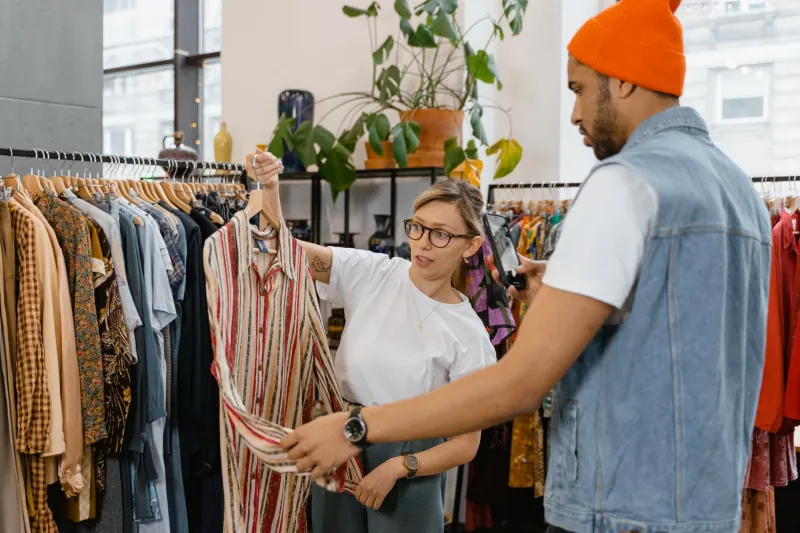
Her name was probably Margaret, or Doris, or Helen. She worked the women's coats department at the downtown store for nineteen years. She knew the inventory the way a librarian knows the stacks — not from a system, but from being there. She could tell you which manufacturer ran small, which lining wouldn't hold up past two winters, and whether the camel-colored one in the window was worth the price or just well-displayed.
She also, if you'd shopped there before, probably remembered you.
That figure — the knowledgeable, long-tenured sales associate who functioned less like a cashier and more like a trusted advisor — was once a standard feature of American retail. Today she is nearly extinct. And the shopping experience that replaced her is so different that most people under forty have no reference point for what was lost.
The Department Store as Institution
At their peak, America's great department stores were civic landmarks. Marshall Field's in Chicago. Macy's in New York. Filene's in Boston. Nordstrom in Seattle. Neiman Marcus in Dallas. These weren't just retail spaces — they were destinations, with restaurants, beauty salons, and in some cases, concert halls and art exhibitions. A trip downtown to the department store was an event.
What made the shopping experience distinctive wasn't the architecture or the lunch counter, though. It was the staff.
Department stores in the mid-20th century employed sales associates who genuinely specialized. The woman in hosiery knew hosiery. The man in men's suits had often been trained in tailoring and could assess your proportions with a practiced eye before you'd said a word. Shoe department staff were routinely trained in foot measurement and gait. These weren't teenagers earning minimum wage between semesters. Many of them had been in the same department for a decade or more, and their expertise was real.
The relationship between customer and associate could develop over years. Regular shoppers were remembered — their sizes, their preferences, their budgets, their occasions. When the store received new merchandise that matched a customer's taste, some associates would set items aside and call the customer directly. This wasn't a loyalty app algorithm. It was a person making a judgment call based on accumulated knowledge of another person.
The Economics of Expertise
This model worked because the economics supported it. Department stores operated on relatively healthy margins, and full-time, career-track sales positions were standard. An experienced associate represented a genuine investment — someone who reduced returns, increased basket size, and built customer loyalty that translated directly to repeat business.
The associate's expertise also served as a quality filter. A knowledgeable salesperson could steer a customer toward the better-made item, explain why the cheaper option would disappoint, and prevent the kind of purchase regret that ends in a return and a lost sale. They were, in a real sense, part of the store's quality control.
That model began breaking down in the 1980s and collapsed through the 1990s as discount retail and big-box stores restructured the competitive landscape. When Walmart and Target demonstrated that Americans would shop at volume if the price was low enough, the pressure on traditional department stores became enormous. The response, almost universally, was cost-cutting — and the easiest cost to cut was labor.
Full-time career associates were replaced with part-time workers. Specialized departments were consolidated. Training programs were reduced. The institutional knowledge that had accumulated over decades walked out the door with the people who carried it, and wasn't replaced.
The Self-Service Era
What filled the gap was a philosophy shift: from consultation to self-service. The modern retail floor assumes that customers arrive already knowing what they want, or will figure it out by browsing. Staff are present for transaction processing — running the register, handling returns — not for guidance.
And for many purchases, this works fine. If you know your size, know the brand, and know what you want, you don't need Margaret from the coat department. You can find it yourself, or order it online in thirty seconds.
But a significant category of purchases doesn't work that way. Suits, formal wear, furniture, appliances, high-end cosmetics, prescription eyewear, specialty footwear — these are items where genuine expertise changes the outcome. Where the wrong choice is expensive and the right one requires knowledge the customer doesn't have.
For these purchases, we've largely replaced the expert associate with online reviews. Which is a fascinating substitution when you think about it: instead of one person who knows a great deal and knows you, we now consult thousands of strangers who know a little and know nothing about us. The volume of information has increased enormously. The relevance of any individual piece of it has dropped sharply.
What Nordstrom Figured Out (and Then Struggled to Keep)
It's worth noting that some retailers understood what was being lost and tried to preserve it. Nordstrom built its entire brand identity around service quality and associate expertise, and for a long time it worked. Their sales staff were compensated on commission, which created an incentive to develop genuine product knowledge and customer relationships. The company's customer service reputation became legendary in retail circles.
But even Nordstrom has faced pressure in the e-commerce era. When the same item is available online for less, and the customer can read five hundred reviews before buying, the value proposition of the knowledgeable associate has to be extraordinarily clear to justify the premium. It's a harder argument to make than it used to be.
The broader lesson may be that expertise in retail was never valued on its own terms — it was valued because it was the only efficient way to navigate a complex purchase. Once technology offered an alternative navigation system, the human one started to look optional.
What We're Still Missing
Here's what the algorithm can't replicate: the moment when someone who has watched you try on six jackets says, quietly, "Not that one. The third one was the one." And she's right, and you know she's right, and you buy the third one and wear it for eight years.
That judgment — rooted in experience, calibrated to you specifically, delivered by someone with no particular stake in which jacket you choose — is genuinely valuable. It saves time, money, and the particular frustration of a purchase that looked right and felt wrong from the first week.
We haven't found a digital substitute for it. The recommendation engine knows what people like you bought. It doesn't know what works for you. The five-star review tells you the product is good. It doesn't tell you it's good for your life.
Margaret on the third floor knew the difference. And we didn't realize what we had until the store closed and the building became condominiums.