A Deal Was a Man's Name and a Firm Grip: How American Business Lost Its Human Core
A Deal Was a Man's Name and a Firm Grip: How American Business Lost Its Human Core
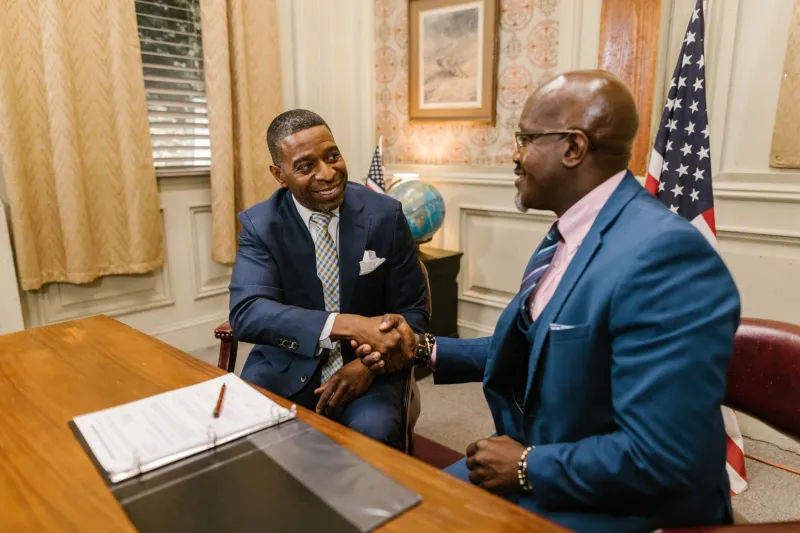
Somewhere around the middle of the last century, you could walk into a supplier's office, shake hands across a desk, and walk out with an agreement that both parties would honor for years. No thirty-page contract. No legal review. No digital signature platform sending automated reminders. Just two people who knew each other — and knew what their reputation was worth.
That world didn't disappear overnight. It eroded slowly, deal by deal, merger by merger, until the personal dimension of American commerce became something older generations mention wistfully and younger ones find genuinely difficult to imagine.
When Business Was Conducted Over Lunch, Not Over Email
In mid-century America, the business lunch wasn't a perk. It was infrastructure. Relationships between vendors, clients, and partners were built across restaurant tables, on golf courses, and at community events that had nothing to do with the transaction at hand. A hardware distributor in Ohio might have supplied the same family-owned hardware stores for thirty years — not because of pricing algorithms or preferred vendor contracts, but because he knew the owner's kids by name and showed up when the roof needed replacing.
The Chamber of Commerce wasn't just a networking formality. It was where the town's economic life actually happened. Men who competed in the marketplace on Monday were on the same church committee on Sunday. That overlap wasn't a conflict of interest. It was the point. Shared community meant shared accountability. If you cheated someone in a deal, you'd see them at the school board meeting on Thursday.
 Photo: Chamber of Commerce, via c8.alamy.com
This wasn't nostalgia-bait sentimentality — it was a functional system. Trust reduced transaction costs in ways nobody had a name for yet. When you knew someone's character personally, you didn't need to anticipate every possible dispute in writing. The relationship itself was the safety net.
The Rise of the Formal Everything
As American businesses grew larger and more geographically spread out through the 1960s and 70s, the personal network started to strain under its own weight. A regional chain couldn't rely on the owner knowing every supplier personally. A corporation with offices in twelve states needed standardized agreements that didn't depend on individual relationships.
Legal formalism filled the gap that personal trust had occupied. Contracts got longer. Procurement processes got more structured. Corporate compliance departments appeared. By the 1980s, a handshake deal was increasingly something you did only with people you'd already met through a formal vetting process — which somewhat defeated the original purpose.
This shift wasn't purely cynical. Formal contracts genuinely protect both parties. Clear terms prevent misunderstandings. Legal accountability is real accountability. The problem wasn't that formalism arrived — it's that it arrived as a replacement for relationships rather than a complement to them.
What the Numbers Don't Capture
Here's something worth sitting with: the old system worked partly because business was local and partly because it was slow. A supplier in 1955 wasn't competing with seventeen overseas alternatives who could undercut his price by 40 percent. Loyalty made economic sense because options were limited and switching costs were real.
Today's global marketplace genuinely requires different structures. Nobody seriously argues that a Fortune 500 company should run its procurement on handshakes. The scale alone makes that impossible.
But something got lost in the translation that isn't fully captured by efficiency metrics. The mid-century business relationship carried a social weight that pure transactionalism doesn't. When the hardware distributor's business hit a rough patch, his long-term clients sometimes carried him through it — not because a contract required it, but because the relationship warranted it. That kind of informal resilience doesn't show up in quarterly reports, and it doesn't survive in a system built entirely around lowest bid and thirty-day payment terms.
Remote Work Finished What Corporate Culture Started
If the shift to corporate anonymity began in the 1970s, the move to remote and hybrid work in the 2020s may have completed it. Business relationships that once involved shared physical space — offices, conference rooms, the involuntary socialization of proximity — now exist almost entirely through screens.
You can work alongside someone for three years and never learn anything about their life outside of their professional function. That's not a criticism of remote work as a policy. It's an observation about what professional relationships require to develop depth, and how much of that development used to happen accidentally, through the ordinary friction of being in the same place.
The irony is that we now have more communication tools than at any point in history, and yet the average American professional probably has fewer genuinely close business relationships than their grandfather did with a rotary phone and a Ford pickup.
What a Handshake Actually Meant
It's easy to romanticize the old model and gloss over its real limitations. Mid-century American business networks were also exclusionary in ways that mattered enormously — built largely by white men, for white men, in communities where women and minorities were systematically shut out of the informal trust networks that greased the wheels of commerce. The personal relationship system had a dark side: it also meant that who you knew determined what you could access, and the wrong background could close doors that no contract law could force open.
Progress on that front has been real and genuinely important. Formal processes and legal structures have created pathways that personal networks once blocked.
But acknowledging those flaws doesn't require pretending nothing was lost. Somewhere between the exclusive old-boys'-club handshake and the forty-page vendor agreement lies a version of professional trust that American business hasn't quite figured out how to rebuild — one that's personal without being exclusionary, accountable without being adversarial, and human without being naive.
For now, the lawyers stay in the room. The lunches are expensed and documented. And the deal that once lived in two people's word lives instead in a cloud-based contract management system with automated renewal alerts.
Efficient. Airtight. And somehow a little lonelier than it used to be.