A Quarter Bought You Paradise: When America's Public Pools Were Everyone's Country Club
The Democracy of Deep Water
Step into any American suburb today and you'll see backyard pools tucked behind privacy fences, community pools locked behind keycards, and fitness centers charging $80 monthly memberships. But travel back to 1955, and you'd find something remarkable: public swimming pools that actually belonged to the public.
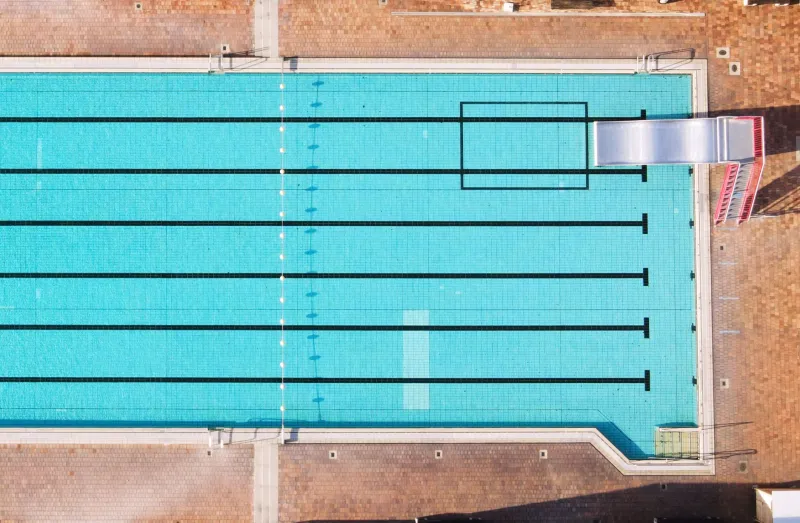
For a quarter—less than the cost of a Coca-Cola—any American could walk into their municipal pool complex and spend an entire day in what amounted to a water-based country club. These weren't the stripped-down, liability-conscious facilities we know today. They were elaborate social institutions complete with diving boards that soared twenty feet high, separate pools for different skill levels, and bathhouses that rivaled small hotels.
The Palisades Pool in New Jersey could hold 3,000 swimmers simultaneously. Chicago's massive complexes featured Olympic-sized pools, wading areas for toddlers, and sprawling sun decks where families claimed territory with striped towels and picnic baskets. These places operated like small cities, with their own rules, hierarchies, and daily rhythms.
 Photo: Palisades Pool, via play-lh.googleusercontent.com
Where Strangers Became Neighbors
What made these pools revolutionary wasn't their size—it was their accessibility. In an era when country clubs remained exclusive and private pools were luxuries for the wealthy few, municipal pools offered something unprecedented: genuinely democratic recreation.
A factory worker's family swam alongside the bank president's children. Teenagers from different high schools met over games of Marco Polo. Elderly residents claimed the same poolside chairs day after day, becoming unofficial neighborhood mayors who knew everyone's business and helped watch everyone's kids.
The pool wasn't just where you went to cool off—it was where communities actually formed. Romances bloomed between lifeguards and regular swimmers. Parents organized carpools while their children learned to dive. Local businesses sponsored swimming lessons and pool parties, weaving themselves into the social fabric of summer.
The Unsupervised Summer
Perhaps most remarkably, these pools operated on a level of trust that seems impossible today. Children as young as eight would bike to the pool in the morning, spend the entire day unsupervised, and return home sunburned and exhausted as streetlights flickered on.
Lifeguards were typically teenagers themselves—high school students who earned respect through whistle-blowing authority and the ability to execute perfect rescues. They managed hundreds of swimmers with nothing more than sharp eyes and loud voices. No liability waivers, no parental supervision requirements, no background checks for every adult who wanted to help a struggling swimmer.
The pool's rhythm followed the natural arc of summer days. Morning belonged to serious swimmers doing laps and elderly residents taking gentle exercise. Afternoons exploded with children's chaos—diving contests, underwater tea parties, and elaborate games that spanned the entire facility. Evenings brought teenagers and young adults, transforming the space into an outdoor social club where relationships formed under the glow of underwater lights.
The Business of Community Fun
These pools operated on economics that seem fantastical today. Municipal budgets covered construction and maintenance as a matter of civic pride, not grudging necessity. Admission fees were set to cover basic operations, not generate profit. Concession stands sold hot dogs and candy at prices designed to accommodate children's allowances, not maximize revenue.
Many pools employed dozens of local residents—lifeguards, maintenance crews, concession workers, and swimming instructors who taught lessons for a few dollars. These jobs provided summer employment for high school and college students, creating a pipeline of young people invested in their community's recreational life.
The pools also anchored broader entertainment ecosystems. Drive-in theaters and ice cream stands clustered nearby, creating summer entertainment districts where families could spend entire evenings without traveling more than a few blocks.
The Quiet Revolution That Changed Everything
The decline of America's great public pools happened gradually, then suddenly. Suburban sprawl moved families away from urban centers. The rise of private backyard pools made municipal facilities seem less special. Liability concerns transformed freewheeling community spaces into heavily regulated, insurance-conscious operations.
By the 1980s, many of the grand pool complexes had been downsized, privatized, or demolished entirely. The elaborate diving platforms disappeared first—too dangerous, too expensive to insure. The sprawling sun decks were fenced off or converted to other uses. The sense of community ownership gradually gave way to fee-for-service relationships between customers and facility managers.
Today's aquatic centers, while often impressive, serve a fundamentally different social function. They're fitness facilities and recreation centers rather than community gathering places. You pay monthly memberships instead of daily admission. You interact with staff rather than neighbors. You schedule your visit around programmed activities rather than simply showing up to see who else might be there.
What We Lost in the Deep End
The transformation of American swimming culture reflects a broader shift in how we think about public space and community life. Those quarter-admission pools represented a collective investment in shared joy—the radical idea that access to recreation shouldn't depend on individual wealth or private club membership.
They also embodied a level of social trust that seems almost naive today. The assumption that strangers would look out for each other's children, that teenagers could be trusted with real responsibility, that communities could manage risk through informal social contracts rather than formal legal structures.
When we marvel at old photographs of packed public pools—thousands of bodies sharing the same water, children diving from towering platforms, families picnicking on crowded decks—we're not just seeing a different approach to swimming. We're glimpsing a fundamentally different understanding of what it meant to live in community with strangers, and how little it once cost to buy your way into paradise.