The Black Bag at Your Bedside: When American Doctors Made the World Their Office
The Doctor Who Knew Where You Kept the Spare Key
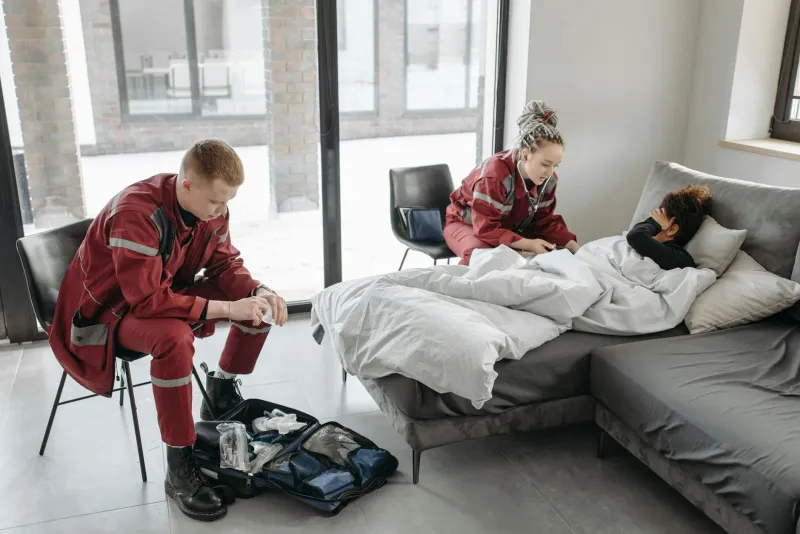
Dr. William Hartley kept his medical bag packed by the front door of his suburban Chicago home for thirty-seven years. Inside: a stethoscope, blood pressure cuff, thermometer, syringes, vials of penicillin, and enough basic supplies to handle a heart attack, deliver a baby, or set a broken arm. Between 1945 and 1982, that black leather bag accompanied him to kitchen tables, bedroom nightstands, and farmhouse porches across three counties—because in mid-century America, your doctor didn't just treat you. He came to you.
Hartley wasn't unusual. He was the norm. In 1950, house calls accounted for 40% of all doctor-patient interactions in America. By 1980, that number had dropped to less than 1%. Today, it's virtually zero outside of specialized concierge medicine that costs thousands of dollars annually.
What disappeared wasn't just convenience. It was an entire model of healthcare that had defined American medicine since the colonial era—one where doctors knew their patients' families, living conditions, and daily routines as intimately as their medical histories.
Medicine That Traveled to You
The house call era operated on principles that seem almost fantastical today. Doctors maintained "call schedules" where they'd visit patients on regular routes, like postal workers delivering mail. They knew which houses had sick children before they knocked, which elderly patients lived alone, and which families couldn't afford to miss work for a clinic visit.
Dr. Margaret Chen, who practiced in rural Vermont during the 1960s, recalls making rounds that could stretch twelve hours: "You'd start at dawn with the Johnsons' new baby, stop by the Millers' farm to check on their diabetic father, then end up delivering twins at the Kowalski place at midnight. Your office was wherever people needed you."
The logistics seem impossible by today's standards. Doctors carried portable versions of medical equipment that now fills entire rooms. They performed minor surgeries on dining room tables, delivered babies in bedrooms, and diagnosed illnesses using only what they could carry in a bag weighing less than twenty pounds.
More importantly, they treated patients within the context of their actual lives. A doctor examining a child with recurring respiratory problems could see the coal stove, the damp basement, or the moldy wallpaper that might be contributing factors—environmental clues invisible in a sterile examination room.
The Economics of Coming to You
House calls weren't just medically effective; they were economically sensible for both doctors and patients. In 1960, the average house call cost $5 (about $45 today), compared to $3 for an office visit. The small premium reflected travel time, but it also meant patients didn't lose wages, arrange childcare, or struggle with transportation.
For doctors, house calls were profitable because they could see more patients per day by clustering visits geographically. Dr. Robert Walsh, who practiced in Boston's North End during the 1950s, typically saw twelve to fifteen patients daily through house calls, compared to eight to ten in his office.
Insurance companies actually preferred house calls for certain conditions. A doctor treating pneumonia at home could monitor the patient's recovery over several days without the cost of hospitalization. Elderly patients with chronic conditions received ongoing care that prevented expensive emergency situations.
When Medicine Moved Behind Walls
The transformation happened gradually, then all at once. Several forces converged in the 1960s and 1970s to make house calls economically unviable and medically obsolete—or so it seemed.
First, medical technology advanced beyond what could fit in a doctor's bag. X-ray machines, laboratory equipment, and diagnostic tools required patients to come to the equipment rather than vice versa. A doctor could no longer provide comprehensive care with just a stethoscope and intuition.
Second, medical specialization exploded. The era of the general practitioner who handled everything from broken bones to heart conditions gave way to specialists who focused on specific body systems or diseases. Coordinating care required patients to visit multiple doctors in clinical settings.
Third, insurance reimbursement policies began favoring office visits over house calls. Medicare, introduced in 1965, paid doctors more for office visits than home visits, despite the latter often taking more time and providing more comprehensive care.
Finally, suburbanization spread patients across larger geographic areas, making house call routes inefficient. A doctor who once served three city blocks now had patients scattered across twenty miles of suburban sprawl.
What We Lost When Doctors Stopped Coming
The end of house calls marked more than a shift in healthcare delivery—it fundamentally altered the doctor-patient relationship. When doctors treated patients in their homes, they functioned as family advisors, community figures, and medical professionals simultaneously.
Patients developed long-term relationships with doctors who understood their family dynamics, financial constraints, and living situations. Dr. Sarah Mitchell, who made house calls in rural Alabama until 1979, remembers: "I knew which of my patients couldn't afford their medications, which ones had family members who could help with care, and which ones were dealing with problems that went way beyond their medical symptoms."
This intimate knowledge translated into more personalized, effective care. A doctor treating depression could see the patient's home environment, family interactions, and daily routine—context that's impossible to gather in a fifteen-minute office visit.
House calls also democratized healthcare access. Elderly patients, disabled individuals, and families without reliable transportation received the same quality of care as those who could easily travel to medical offices. Geographic and economic barriers to healthcare were significantly lower when doctors came to patients.
The Brief Revival That Never Took
By the 1990s, some healthcare providers began recognizing what had been lost. Concierge medicine practices started offering house calls as a premium service, charging annual fees of $2,000 to $10,000 for the privilege of having a doctor visit your home.
Several startups attempted to revive house calls using modern technology and logistics. Companies like Heal and Pager promised to send doctors to patients' homes within hours of a request, using apps to coordinate visits and electronic medical records to maintain continuity of care.
But these efforts remained niche services for affluent patients rather than mainstream healthcare options. The fundamental economics and infrastructure of American medicine had shifted too dramatically to accommodate widespread house calls.
The Examination Room Generation
Americans under forty have never experienced healthcare as a service that comes to them. For this generation, being sick means traveling to medical care, waiting in sterile rooms, and interacting with doctors who know their symptoms but not their lives.
The contrast is stark: their grandparents received medical care from doctors who knew their families, their homes, and their communities. Today's patients receive care from doctors who might not even remember their names between visits.
This shift has profound implications for healthcare outcomes, patient satisfaction, and the fundamental experience of illness in America. When doctors stopped making house calls, medicine gained technological sophistication but lost something equally valuable—the understanding that health exists within the context of how people actually live their lives.
The black bag by the door represented more than medical equipment. It symbolized a healthcare system that came to patients rather than requiring patients to come to it—a model that seemed outdated until a global pandemic reminded us that sometimes, the best medicine really is delivered wherever people need it most.