Wrong Turns Were Part of the Plan: When Americans Actually Got Lost on Purpose
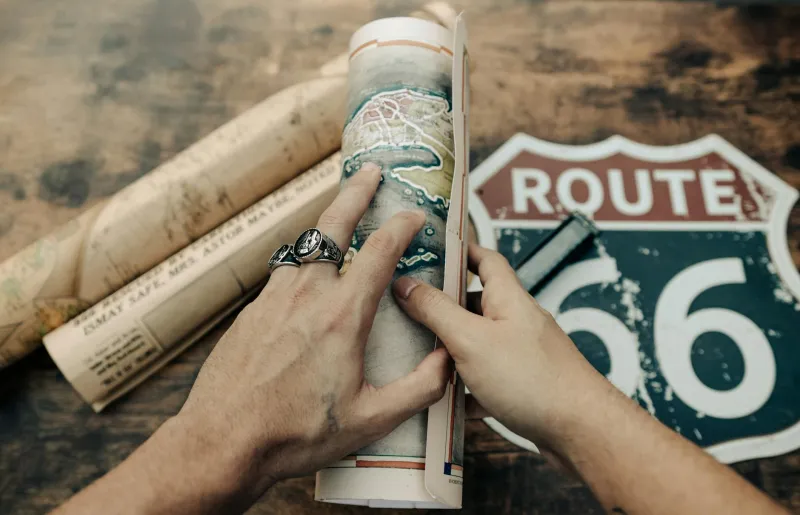
The Last Generation to Fold Paper
In 1995, if you wanted to drive from Chicago to Denver, you started at a gas station. Not for fuel—though you'd need plenty—but for maps. Real, physical maps that unfolded into unwieldy sheets of paper covered in red and blue lines, each representing roads you might never find again.
The ritual was as American as the road trip itself. You'd spread the map across your kitchen table, trace potential routes with your finger, and circle rest stops in towns you'd never heard of. Then you'd fold it back up—never quite the same way it came—and hope for the best.
When Gas Station Attendants Were Your GPS
Before smartphones put the world's knowledge in your pocket, local expertise lived behind the counter at every Texaco and Shell station. These weren't just cashiers—they were unofficial ambassadors to their slice of America, ready to sketch directions on the back of a receipt or point you toward the best diner in three counties.
"Take Highway 34 west until you see the big red barn, then turn left at the church," they'd say, as if everyone knew which red barn they meant. And somehow, most of the time, you found it.
These interactions weren't just about navigation—they were cultural exchanges. A gas station attendant in rural Kansas might recommend a shortcut through wheat fields, while someone in the Colorado Rockies would warn you about mountain passes that closed without notice. Getting directions meant getting stories, local history, and warnings about speed traps all rolled into one conversation.
The Art of Being Temporarily Lost
What modern Americans don't fully grasp is that getting lost wasn't considered a disaster—it was part of the experience. Families would pack extra snacks and build buffer time into their schedules because wrong turns were inevitable. The phrase "scenic route" often meant "we have no idea where we are, but the countryside looks nice."
This acceptance of uncertainty created a different relationship with travel itself. Without the constant reassurance of a blue dot showing your exact location, you had to pay attention to your surroundings in ways that seem almost quaint now. You noticed landmarks, read road signs carefully, and developed an intuitive sense of direction that GPS has largely eliminated.
Parents would designate one child as the "navigator," teaching them to read maps and watch for highway markers. These weren't just road trip games—they were practical skills that could determine whether you made it to Yellowstone or ended up in some town in Wyoming you'd never heard of.
The Infrastructure of Getting Found
Before cell phones, America built an entire infrastructure around the assumption that travelers would occasionally lose their way. Highway rest stops weren't just places to stretch your legs—they were information hubs with detailed regional maps, local attraction brochures, and staff who could orient confused families.
Motels advertised their proximity to major highways because being easy to find was a competitive advantage. Restaurant chains like Howard Johnson's built their orange roofs tall and bright specifically so lost drivers could spot them from miles away. Even McDonald's golden arches served as navigational aids—a familiar sight that meant civilization and, hopefully, someone who could point you in the right direction.
AAA TripTiks represented the gold standard of pre-digital navigation. These personalized strip maps, hand-assembled by AAA employees, showed your exact route highlighted in fluorescent marker. Getting a TripTik felt like receiving official sanction for your journey, complete with recommended stops and alternate routes marked in different colors.
What We Lost When We Stopped Getting Lost
Modern GPS has eliminated more than just wrong turns—it's changed the fundamental nature of American travel. When every journey becomes a series of voice commands ("In 500 feet, turn right"), we stop engaging with the landscape as a navigational puzzle to be solved.
The skills that previous generations took for granted—reading paper maps, estimating distances, remembering landmark sequences—have largely disappeared. More subtly, we've lost the tolerance for uncertainty that made American road trips feel like genuine adventures rather than efficient point-to-point transportation.
Today's travelers follow optimal routes calculated by algorithms, missing the spontaneous discoveries that came from taking a wrong turn and stumbling onto a local festival, a roadside attraction, or a family-owned restaurant that served the best pie in three states.
The Freedom of Not Knowing
Perhaps most significantly, we've lost the particular freedom that came from being temporarily disconnected from the larger world. When you were genuinely lost on a back road in Montana, with no cell service and only a paper map for guidance, you existed entirely in that moment and place. There was no option to check email, no GPS recalculating your route, no digital leash connecting you to obligations elsewhere.
This forced presence—the inability to be anywhere other than exactly where you were—created a different quality of travel experience. It demanded patience, encouraged conversation with strangers, and made arrival at your destination feel like a genuine accomplishment rather than the inevitable result of following turn-by-turn directions.
The next time your GPS loses signal and you're momentarily unsure of your location, remember: an entire generation of Americans navigated this country with nothing but paper maps, local knowledge, and the understanding that sometimes the best journeys happen when you don't know exactly where you're going.