When the TV Decided What You Watched: The Scheduled Life of American Entertainment
When the TV Decided What You Watched: The Scheduled Life of American Entertainment
Somewhere in the mid-1960s, on a Tuesday evening at 8 p.m., roughly 50 million Americans sat down in front of their televisions at exactly the same moment to watch exactly the same thing. Not because a recommendation algorithm had surfaced it. Not because a friend had texted them about it. Because NBC had decided that was when it was on, and that was simply how it worked.
If you missed it, you missed it. There was no catch-up service, no next-day stream, no way to pause and come back. The show existed in one place, at one time, and then it was gone — held only in memory until, maybe, a summer rerun.
This is not ancient history. It describes American life within living memory. And yet the distance between that world and this one is almost impossible to overstate.
The Schedule Was the Product
In the postwar decades, American entertainment wasn't something you chose. It was something you were offered, on a take-it-or-leave-it basis, by three television networks and a handful of local stations. The TV Guide — a magazine so essential it was once one of the best-selling publications in the country — was the map. You read it at the start of the week, circled what you wanted, and arranged your evenings accordingly.
This created a genuinely different relationship with time. Tuesday night was a specific thing. So was Saturday night. Families didn't ask 'what do you want to watch?' — they asked 'what's on?' The distinction sounds small. It wasn't. One is an act of choice. The other is an act of coordination with a national schedule you had no hand in setting.
Radio had established this logic even earlier. Before television, American families gathered around a receiver in the living room to follow serialized dramas and comedy programs on a weekly schedule. Missing an episode of Amos 'n' Andy or The Lone Ranger in the 1940s meant losing a thread in an ongoing story with no way to recover it. Engagement with popular culture required showing up on time, every time.
Going Out Was a Production
For entertainment outside the home, the logistical requirements were even more pronounced. The drive-in movie theater — a genuine institution in postwar American suburban life — required you to arrive before the film started, find a spot, and commit to the experience for the duration. You could not pause for a bathroom break without missing something permanent.
A night out at the movies in 1955 was an event planned days in advance. You checked the newspaper for showtimes. You called ahead, sometimes, to ask what was playing. If the film you wanted to see wasn't at your local theater, and you didn't have a car, you simply didn't see it. Films had theatrical runs measured in weeks, not the wide simultaneous releases of today. A movie might open in New York in October and not reach a small-town theater in Ohio until February.
The bowling alley, the drive-in, the local dance hall — these were not backup options when Netflix didn't have anything good. They were the primary social infrastructure of American leisure, and they required planning, transportation, and a willingness to leave the house that modern entertainment has made entirely optional.
One Television, Many Compromises
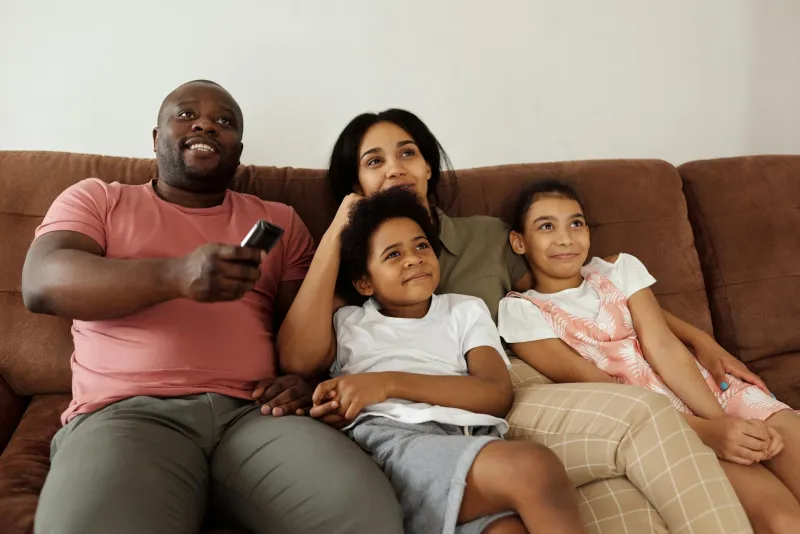
In 1955, roughly 65 percent of American homes had a television set. By 1965, that figure was over 90 percent. But in most households, there was one. A single screen, in a single room, shared by everyone under the roof.
This had consequences for family dynamics that are genuinely hard to imagine from the vantage point of a household where every member has a personal device capable of streaming any content ever produced. Decisions about what to watch were negotiations — sometimes heated ones. Children watched what parents chose. Teenagers didn't disappear into their rooms with a phone. The living room was the arena, and whatever was on was watched communally, or not at all.
The remote control, widely adopted in American homes only in the late 1970s and early 1980s, is often treated as a minor convenience. In reality, it was the first crack in a system that had required audiences to be passive recipients of whatever was broadcast. Once you could change the channel without getting up, the logic of scheduled appointment television began, very slowly, to erode.
What Shared Schedules Created
There's something worth sitting with in this picture, beyond the inconvenience. When 50 million people watch the same thing at the same moment, it creates a particular kind of shared culture. The morning after a major broadcast event — a moon landing, a presidential address, a season finale — everyone had seen it. Conversation had a common reference point that required no explanation and no catch-up.
Today's fragmentation of content has produced extraordinary abundance. The quality of available television, film, and audio content in 2024 is not remotely comparable to what existed in 1960. But the shared cultural moment — the thing everyone saw, together, last night — has become genuinely rare. The Super Bowl still manages it. Not much else does.
The Infinite Library and What It Changed
The arrival of the VCR in the late 1970s was the first real break in the broadcast model. For the first time, Americans could time-shift: record a program and watch it later. It seems modest now. At the time, the television industry treated it as an existential threat, and in a structural sense, they were right. It was the beginning of a decades-long transition that ended in a world where the concept of 'what's on' has been replaced entirely by 'what do you want.'
Streaming didn't just change how we watch. It changed what watching means. It is now a solitary, asynchronous, infinitely customizable activity. The idea that your entertainment choices are shaped by a broadcaster's schedule, or that missing something means losing it permanently — those ideas have become almost quaint.
The distance from then to now isn't just technological. It's a complete reordering of how leisure time is structured, shared, and experienced. That's worth knowing.