It's Tuesday afternoon and you're wondering: What's the capital of Mongolia? How do you remove red wine stains? What year did the Titanic sink? Today, these questions get answered in seconds. But for most of American history, they might have stayed mysteries for months, years, or forever.
This wasn't just an inconvenience. It was a fundamentally different way of experiencing the world — one that shaped how people thought, learned, and connected with each other in ways we're only beginning to understand as we lose them.
The Encyclopedia Salesman Was Your Gateway to Knowledge
In 1960, if you wanted reliable information at home, you bought an encyclopedia set. Not the book — the entire set. Twenty-four volumes of Encyclopædia Britannica cost about $400, roughly $4,000 in today's money. Families saved for years to afford them.
The encyclopedia salesman was a fixture of American suburbs, armed with sample volumes and payment plans. He wasn't just selling books; he was selling the promise that your family would never again be caught not knowing something important. Parents saw it as an investment in their children's future, like a college fund made of paper and binding.
But even with an encyclopedia, knowledge had limits. The 1965 Britannica was already outdated the day it was printed. Current events, recent discoveries, new technologies — these existed in a knowledge gap that only newspapers and magazines could partially fill.
When the Library Was Your Search Engine
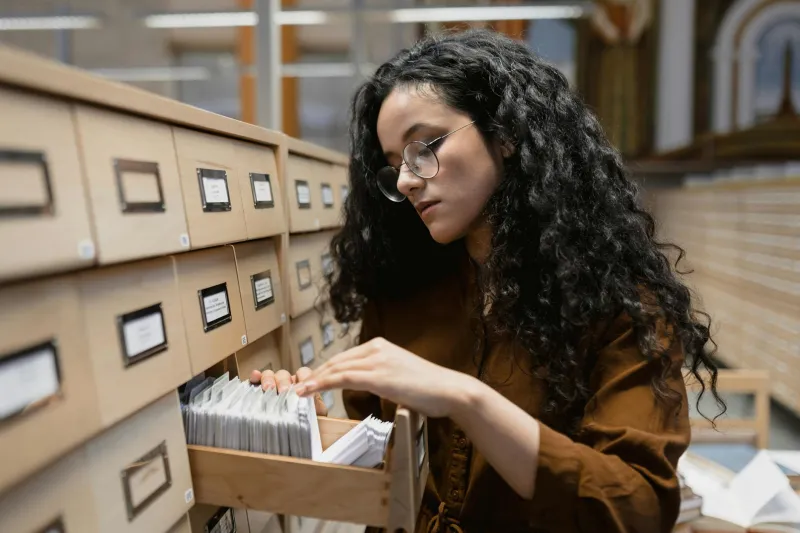
For anything beyond basic facts, Americans relied on librarians — the original search engines in human form. A good reference librarian could navigate card catalogs, remember which books contained specific information, and guide you through research in ways that made them part detective, part teacher, part miracle worker.
"Mrs. Henderson at the downtown library knew more than Google does now," remembers 72-year-old Tom Walsh from Cleveland. "You'd call and say, 'I need to know about growing tomatoes in Ohio,' and she'd have three books pulled for you by the time you got there."
But libraries had hours. They closed at 6 PM and stayed closed on Sundays. If a question struck you at midnight or during a family dinner, it had to wait. This created a different rhythm of curiosity — questions accumulated until you could get to a library, creating anticipation and making answers feel more valuable when you finally found them.
The Neighborhood Expert System
Without instant access to information, Americans developed informal networks of expertise. Every neighborhood had its specialists: the guy who knew cars, the woman who could identify any plant, the couple who had traveled and could tell you about distant places.
These human search engines served functions beyond just answering questions. They created social connections, mentorship opportunities, and community bonds. Learning something meant building a relationship. Getting an answer often meant having a conversation that led to other discoveries, other connections, other questions.
Families developed internal expertise too. Dad might be the go-to for mechanical problems, Mom for cooking questions, Uncle Joe for anything related to the war. Knowledge was distributed across the social network, making everyone both teacher and student.
The Art of Living with Uncertainty
Perhaps most importantly, Americans learned to function with incomplete information. If you couldn't remember the name of that actor from that movie, you might spend weeks trying to recall it. Bar arguments about sports statistics could last for hours because there was no quick way to settle them.
This uncertainty bred different habits of mind. People became comfortable with phrases like "I think it was..." or "If I remember correctly..." They developed better memories because they couldn't outsource everything to external sources. They also became better at reasoning from partial information and making decisions without perfect knowledge.
Dinner table conversations had a different quality when disagreements couldn't be instantly resolved. Families would debate historical dates, geographical facts, or scientific principles, with the understanding that the "right" answer might have to wait until someone could get to the library. This made conversations longer, more exploratory, and often more creative.
When Research Was an Adventure
Finding information required planning, time, and often physical travel. A high school student writing a paper about the Civil War might spend an entire Saturday at the library, working through multiple sources, taking handwritten notes, and photocopying key pages for a quarter each.
This made research feel like detective work. You'd follow leads from one source to another, discover unexpected connections, and sometimes find answers to questions you didn't know you had. The physical effort invested in finding information made it feel more valuable and more memorable.
College students developed relationships with specific librarians, learned the quirks of different card catalog systems, and could navigate the stacks of their university library like sailors reading the stars. Research skills were survival skills, not just academic exercises.
The Patience That Instant Information Destroyed
Living with unanswered questions required a kind of patience that's become almost extinct. Americans developed the ability to hold multiple unresolved curiosities in their minds simultaneously, revisiting them when new information sources became available.
This patience extended to learning itself. Without YouTube tutorials, mastering a new skill meant finding a human teacher, reading books, and practicing through trial and error. The process was slower but often more thorough, creating deeper understanding and stronger retention.
People also developed better tolerance for ambiguity and conflicting information. When you couldn't instantly fact-check every claim, you learned to hold multiple perspectives simultaneously and make judgments based on source credibility and internal consistency.
What We Lost When Everything Became Knowable
Today's instant access to information has solved the problem of unanswered questions, but it's created new challenges. We've lost the social connections that came from asking human experts. We've lost the patience that made answers feel valuable. We've lost the memory skills that came from not being able to look everything up.
We've also lost something more subtle: the comfort with not knowing. In a world where every fact is supposedly at our fingertips, not knowing something feels like a personal failure rather than a natural state of being. This has made us less tolerant of uncertainty and less skilled at functioning with incomplete information.
The conversation patterns that sustained families and communities for generations — the long discussions, the friendly arguments, the collaborative problem-solving — have been replaced by quick searches and definitive answers that end conversations rather than extending them.
The Hidden Gifts of Ignorance
There was something valuable in the old way of not knowing. It made people better listeners, more curious questioners, and more appreciative of expertise. It created space for wonder, speculation, and imagination in ways that instant answers don't.
It also made knowledge feel more communal. When information was scarce and hard to find, sharing it felt generous. Teaching someone something meant giving them a gift that had cost you time and effort to acquire.
Today we have access to more information than any generation in history, but we may have lost some of the wisdom that came from living comfortably with questions that couldn't be answered immediately. In our rush to know everything, we might have forgotten the value of not knowing — and the human connections that grew in the spaces where knowledge was incomplete.