Three Meals and a Room for Thirty Dollars: America's Forgotten Boarding House Culture
In 1920, if you were a young clerk in Chicago or a traveling salesman in Portland, chances are you lived in a boarding house. Not an apartment, not a hotel, but a peculiar American institution where Mrs. Henderson or Mrs. O'Malley served breakfast at seven sharp, dinner at six on the dot, and expected you to show up with clean hands and conversation ready.
For most Americans today, this sounds like summer camp for adults. But for nearly a century, boarding houses were how millions of people lived, ate, and formed communities in cities across the country.
The Economics of Eating Together
A typical boarding house in 1925 charged between twenty-five and forty dollars a month for a furnished room and three meals a day. To put that in perspective, a factory worker earning twenty dollars a week could afford decent housing and food for less than half his monthly income. Compare that to today, when the median rent alone consumes 30% of household income before you've bought a single grocery.
But the real difference wasn't financial — it was structural. The boarding house bundled shelter and sustenance in a way that seems almost unimaginable now. You didn't worry about meal planning, grocery shopping, or cooking. Mrs. Patterson handled all of that. Your job was to show up on time and contribute to the conversation.
This arrangement shaped an entire economy of urban living. Boarding house keepers were often widows who turned their homes into small businesses, cooking for eight to fifteen residents. They bought wholesale, planned menus around seasonal availability, and served family-style meals that brought strangers together twice a day.
The Ritual of the Common Table
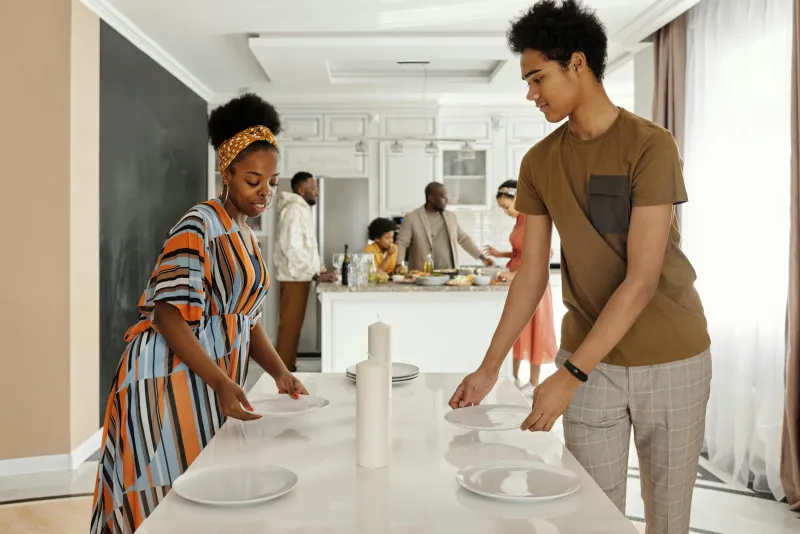
What made boarding houses unique wasn't just the shared meals — it was the enforced sociability. Dinner wasn't served in your room or grabbed on the go. Everyone gathered around a large dining table, passed dishes, and made conversation with whoever happened to sit nearby.
This created an odd intimacy among people who might otherwise never speak. The traveling shoe salesman sat next to the bank clerk, who passed the potatoes to the schoolteacher, who argued politics with the insurance agent. Boarding houses were accidental melting pots where Americans from different backgrounds, regions, and social classes mixed in ways that rarely happen today.
The rules were simple but strict: be on time, dress appropriately, contribute to conversation, and treat the landlady with respect. Miss too many meals without notice, and you'd find yourself looking for new lodgings. The boarding house operated on a social contract that balanced individual privacy with collective responsibility.
When Privacy Became More Important Than Community
The boarding house began its decline in the 1930s, accelerated through the postwar boom, and was essentially extinct by 1970. Several forces conspired to kill it: rising wages that made private apartments affordable, changing social attitudes that valued privacy over community, and new housing policies that favored single-family homes and individual apartments.
But perhaps most importantly, American women increasingly rejected the role of boarding house keeper. Managing a house full of strangers, cooking three meals a day, and maintaining order around the dinner table was exhausting work that offered little social status. As other opportunities opened up, fewer women were willing to take it on.
Simultaneously, Americans were embracing a new ideal of domestic life centered on the nuclear family and private space. Sharing meals with strangers began to seem old-fashioned, even slightly unseemly. The boarding house represented an earlier era when community was a necessity rather than a choice.
What We Lost When We Stopped Eating Together
Today's equivalent might be co-living spaces in expensive cities, but even these modern arrangements rarely include shared meals. We've replaced the boarding house with studio apartments, meal delivery apps, and the assumption that eating is primarily a private matter.
The contrast is stark. Where boarding house residents once navigated daily interactions with a diverse group of neighbors, today's urban dwellers can go weeks without speaking to anyone in their building. Where families once gathered around tables with strangers, we now eat alone while scrolling through our phones.
The boarding house wasn't perfect — it could be nosy, restrictive, and occasionally unpleasant. But it solved problems we're still grappling with: affordable urban housing, social isolation, and the burden of daily meal preparation. It created communities by accident and fed people as a matter of course.
The Economics of Isolation
When we abandoned the boarding house model, we didn't just change how Americans lived — we changed how much it costs to live. Instead of sharing the expense of food preparation, utilities, and common spaces, we've individualized these costs. Everyone now pays for their own kitchen, their own dining room, and their own grocery bill.
The result is a housing and food system that's simultaneously more expensive and more isolating. We've traded the minor inconveniences of shared living for the major expense of private everything. And somewhere in that trade, we lost the assumption that meals are social events and that strangers might become neighbors around a dinner table.
The boarding house reminds us that there's nothing inevitable about eating alone or treating food as fuel rather than a reason to gather. For most of American history, sharing a meal with people you didn't choose was just part of how cities worked. That world is gone, but its absence explains a lot about how we live now.