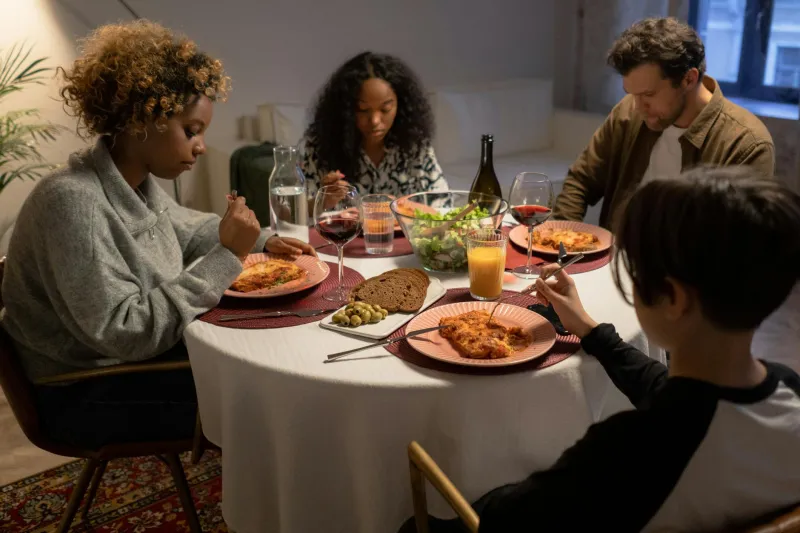
If you traveled back to any American suburb in 1955 and walked the streets at six o'clock on a Tuesday evening, you'd witness something that would seem almost supernatural today: the simultaneous gathering of entire families around dinner tables, like some coordinated domestic ballet performed in living rooms across the country.
This wasn't a special occasion or a weekend tradition. It was Tuesday. And Wednesday. And every other day of the week. The family dinner was as fixed a part of the American schedule as sunrise, and about as negotiable.
The Architecture of Gathering
In the postwar era, American homes were literally designed around the assumption that families would eat together every night. Dining rooms weren't decorative spaces or home offices in disguise — they were the nerve centers of domestic life, furnished with tables large enough for the whole family and positioned to facilitate conversation.
Kitchens opened onto dining areas so the cook could participate in dinner conversation. Living rooms were arranged to encourage post-meal gathering. Even apartment layouts reflected this priority: the dining area was central, visible, and impossible to avoid.
This architectural commitment reflected a deeper social contract. Someone — almost always a woman — would plan, shop for, prepare, and serve a hot meal at a predetermined time. Everyone else would show up, sit down, and participate in the daily ritual of family life.
The Logistics of Universal Dinner Time
Making family dinner work required an entire society organized around the assumption that it would happen. Work schedules ended early enough for commutes home. Children's activities were scheduled around dinner time. Social obligations deferred to the family meal.
The typical American father left work at five, arrived home by six, and expected dinner to be ready. Schools dismissed students early enough for homework and chores before the evening meal. Even television programming reflected these rhythms — family shows aired after dinner, when everyone was gathered together anyway.
This coordination extended beyond individual households. Neighborhoods operated on synchronized schedules that made the daily dinner possible. Stores stayed open during the day when housewives shopped, but closed early enough for employees to get home for their own family meals.
The Social Contract of the Set Table
The family dinner operated under unwritten but universally understood rules. You showed up on time, you helped set and clear the table, you participated in conversation, and you stayed until everyone was finished. Missing dinner without a good reason was a minor family crisis.
This ritual served multiple functions simultaneously. It was how families shared information about their days, how children learned social skills and table manners, how parents maintained connection with their kids' lives. It was quality time before anyone called it that.
The dinner table was where family hierarchies were reinforced and challenged, where news was shared and decisions debated, where children learned to hold up their end of a conversation with adults. It was education disguised as a meal.
The Economics of Always Being Home
The universal family dinner was possible because American society was organized around single-income households where one parent — almost always the mother — was available to make it happen. This wasn't just about cooking; it was about orchestrating the complex logistics of getting everyone fed at the same time.
This arrangement required enormous unpaid labor that we now recognize but rarely discuss. Meal planning, grocery shopping, food preparation, table setting, serving, cleanup, and coordination with everyone's schedules was a full-time job disguised as domestic duty.
But it also created a different kind of family life. Children grew up assuming that someone would always be there to make dinner, that families naturally gathered every evening, that home was a place where you showed up rather than a place you visited between obligations.
When Everything Changed at Once
The family dinner began its decline in the 1970s and collapsed entirely by the 1990s, killed by a combination of forces that arrived almost simultaneously. Women entered the workforce in unprecedented numbers, eliminating the full-time family coordinator. Commutes got longer, making six o'clock arrivals impossible. Children's schedules filled with activities that conflicted with dinner time.
Fast food and microwaves made individual meals convenient, while cable television and video games provided alternatives to family conversation. The economic pressures that forced both parents to work also made the elaborate coordination required for family dinner seem like an unaffordable luxury.
Most importantly, the social expectation that families should eat together every night simply evaporated. What had once been a moral obligation became a lifestyle choice, and choices can be unmade.
The New Geography of Eating
Today's American families eat differently than any generation in human history. Meals happen individually, on personal schedules, often in separate rooms. Family dinner, when it occurs, is a special event requiring planning and coordination rather than a daily assumption.
Children grow up eating in cars, at their desks, and in front of screens. Parents grab food between meetings or after kids' bedtime. The dining room has become a homework station or storage area. The kitchen island has replaced the family table as the center of food consumption.
This isn't necessarily worse, but it's radically different. We've traded the forced togetherness of the daily dinner for the flexibility of individual schedules. We've exchanged the predictability of shared meals for the convenience of eating whenever and wherever we want.
What We Lost in Translation
The disappearance of the universal family dinner represents more than a change in eating habits — it's a fundamental shift in how American families relate to time, space, and each other. The daily gathering that once anchored family life has been replaced by a collection of individual experiences that happen to occur in the same house.
Children who grew up with nightly family dinners learned different lessons about conversation, patience, and shared responsibility than those who eat alone while watching YouTube videos. They experienced a different kind of family intimacy, one built through daily repetition rather than special occasions.
The family dinner also taught practical skills that are now rare: how to participate in group conversation, how to wait for others, how to coordinate individual needs with collective schedules. These seem like small things until you realize how much of adult life requires exactly these abilities.
The Price of Flexibility
Modern family life is undoubtedly more flexible and arguably more fair than the rigid dinner schedules of the 1950s. Parents share domestic responsibilities, children participate in enriching activities, and families adapt to complex schedules in ways that previous generations couldn't imagine.
But this flexibility comes with costs that we're only beginning to understand. Without the forced gathering of the daily dinner, families have to work harder to maintain connection. Without the predictable rhythm of shared meals, children miss lessons in cooperation and conversation that once happened automatically.
The sacred hour of six o'clock dinner reminds us that some of the most important parts of family life happen through repetition rather than intention. When we gave up the daily gathering, we didn't just change when we ate — we changed how families work.